
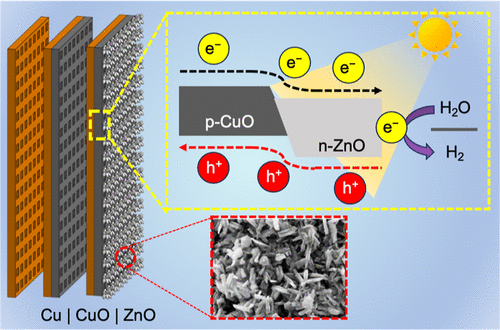
This research enhances the performance of CuO/ZnO heterojunction on Cu substrate (foil or mesh) as photocathode for water splitting by the electrochemical methods, a promising process to build seamless contact between films and substrate by enhancing the electric conductivity. (Riset ini meningkatkan kinerja heterojunction CuO/ZnO pada substrat Cu (lembaran tipis atau jaring) sebagai fotokatoda untuk pemecah air dengan metode elektrokimia, sebuah proses yang menjanjikan untuk membangun lapisan dengan kontak mulus dengan substratnya dengan meningkatnya konduktivitas listriknya.)
Key Problems and Findings:
How seamless contact between film and substrate can be formed? Bagaimana kontak yang mulus antara lapisan dan substrat dapat terbentuk?
By anodizing Cu substrate in KOH solution to grow CuO film from directly Cu substrate and electrodepositing ZnO on it. (Dengan menganodisasi substrat Cu dalam larutan KOH untuk menumbuhkan lapisan CuO langsung dari substrat Cu dan mengelektrodeposisi ZnO di atasnya.)
What is the morphology of the CuO film? Apa morfologi lapisan CuO?
The CuO film grown on both the Cu foil and the Cu mesh are in the form of nanoplates aligned vertically with the substrate. (Lapisan CuO yang tumbuh pada lembaran tipis Cu dan jaring Cu dalam bentuk pelat nano yang tertata secara vertikal dengan substrat.)
What is the morphology after electrodepositing ZnO? (Bagaimana morfologinya setelah elektrodeposisi ZnO?)
The morphology changes to flower-like or nearly spherical when ZnO is deposited by electrodeposition. (Morfologi lapisan berubah menjadi seperti bunga atau hampir bulat ketika ZnO dideposisikan.)
How does the substrate form affect the photoelectrochemical (PEC) performance of the CuO/ZnO heterojunction? (Bagaimana bentuk substrat memengaruhi kinerja fotoelektrokimia heterojunction CuO/ZnO?)
The CuO/ZnO nanostructures grown on the Cu mesh substrate exhibit better PEC performance than their Cu foil counterparts in terms of their open circuit potential (OCP), overpotential and current density. (Struktur nano CuO/ZnO yang ditumbuhkan pada substrate jaring Cu menunjukkan kinerja PEC yang lebih baik daripada lembaran tipis Cu ditinjau dari OCP, overpotensial dan rapat arus.)
These findings provide helpful insights for the development of modern photocathodes with flexibility and effective performance based on inexpensive and earth-abundant materials for future solar hydrogen generation. (Temuan ini memberikan pandangan yang bermanfaat untuk pengembangan fotokatoda modern dengan fleksibilitas dan kinerja yang efektif berdasarkan pada bahan murah dan tersedia di alam dalam jumlah melimpah untuk pembentukan hidrogen dengan sinar matahari.)
Publication: Enhancing the Photoelectrochemical Activity of CuO/ZnO Junction Photocathodes for Water Splitting
December 16, 2024. Langmuir. DOI: 10.1021/acs.langmuir.4c04163
R.A.N. Utama, R. Nabila, T. Nurtono, W. Widiyastuti, T.N. Pratiwi, I.W. Lenggoro, H. Setyawan
Published December 16, 2024 © 2024 American Chemical Society (ACS)
T.N. Pratiwi was Postdoctoral fellow at TUAT and I.W. Lenggoro is Professor at TUAT.
 Electrochemical Engineering Laboratory
Leave a comment